
Environmental history or environmental prophecy?
Ruin and Recovery at Age 25

When a book of history you’ve written becomes history itself, this not only makes you feel old, but also gives you a chance, in hindsight, to see whether it has proven accurate. Ruin and Recovery: Michigan’s Rise as a Conservation Leader was a book I’d long wanted to write. Based on 20 prior years of learning the environmental history of Michigan on the job, it attempted to put in perspective the good and bad in the state’s management of its natural resources.
Despite the catastrophes marking Michigan’s environmental history, I intended the book to capture a stirring story of citizen action to rebuild and protect the air, water, forests, fish and wildlife – and human health – since Michigan became a state in 1837. I was fortunate that the book received a generally warm welcome.
But now it’s time to look back. Although I’m pleased with much of Ruin and Recovery, I also see its flaws. They’re considerable. Here are a few:
· The book was intended to cover Michigan’s environmental history as a state, but in doing so it said virtually nothing about the people who lived here for approximately 10,000 years before that. How did they live in relation to the landscape and waterscape? How did their ways and practices affect these peninsulas?
· The book could have used better editing. It was too long, especially in discussing the details of the legislative process. One reader called that portion of the book “boring government stuff.”
· The book was simplistic in its faith that Michigan would become a conservation leader among the states again.
This faith was founded on the finding that Michigan had lived through several cycles of destruction and healing. First, rapacious logging companies stripped Michigan of its white pine and market hunting and fishing devoured wildlife and aquatic life.
The book was simplistic in its faith that Michigan would become a conservation leader among the states again.
Then citizens organized and successfully pressured state legislators to create forest reserves and commit to a plan of sustainable harvest. They also compelled legislators to enact legislation establishing harvesting seasons and rules.
Similarly, when pollution blackened the sky and poisoned the water, it was citizens who clamored for the cleanup laws that distinguished Michigan among the 50 states.
I projected that this would happen again as new challenges occurred, including urban sprawl, climate change and new forms of air and water pollution.
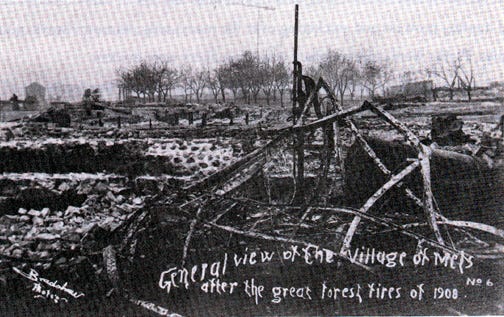
The remains of a murderous 1908 fire in Metz, Michigan, which killed 37 people. The fire was blamed in large part on wood “slash” left behind by loggers when lumber barons abandoned the cutover land.
So far, I’ve been wrong. A political culture resistant to the wishes of the public, unsuccessful tactics used by environmental and conservation groups, and citizens who expect someone else to do the work all contribute to the problem.
In a state where 60% or more of voters support clean air, clean water and outdoor recreation, environmental policy is sputtering.
Some readers have even joked darkly that any future edition of the book should be renamed Ruin and Recovery and Ruin Again. I can’t go that far.
I still take heart from examples of Michigan’s past.
Charles Garfield, a Grand Rapids banker, for 20 years in the late 1800s and early 1900s advocated that the state create a public forest system to replace cutover, fire-charred acres of northern Michigan. Today, the Department of Natural Resources manages 3.9 million acres of state forests.
Genevieve Gillette, a landscape architect, spent 50 years of her life from the 1920s as a volunteer champion of building Michigan’s state park system. Her work contributed to everything from Tahquamenon State Park to Sleeping Bear Dunes National Lakeshore. Today, there are 306,000 acres of state parks and recreation areas.
Joan Wolfe, a citizen advocate living in Belmont, organized and led a coalition of interests that overcame polluter resistance to win state legislative approval of the Michigan Environmental Protection Act in 1970. Today, MEPA stands tall as a landmark law empowering the public.
As Joan said in summarizing the work to enact MEPA, “To me the greatest lesson is: ‘None of us is as smart as all of us,’ and “Nothing we do can be accomplished alone.”
This is no time to fall back on cynicism. And there is no purpose in apathy. Michigan’s environmental challenges are too great. The impulse for environmental recovery in Michigan has always begun with its public. Today, it must again.
The elected and appointed leaders don’t lead. Citizens lead, and public officials follow.
If citizens take the initiative, 25 years from now, an environmental historian can write Ruin and Renewal.
****************************************************************************
NOTE: A new book coming November 1 has received its Library of Congress identity:
Authors, American--Homes and haunts--Michigan
American literature--Michigan
Michigan--In literature
Bookstores--Michigan
Libraries--Michigan
Michigan--Intellectual life
Stay tuned.
Thanks for your insight Dave. It is thoughtful and provoking.
One additional feature of any successful recovery will be we Great Lakes St Lawrence States, Provinces, First Nations, Tribes, Cities and communities will have to work together. These waters and lands are shared responsibilities and can only be recovered together. Our joint strength is powerful politically ( necessary for President and Prime Minister), economically, culturally and naturally with all the fresh water. We just need to discover our path moving forward, stick together and go for it.
Thanks for all you do.
Mark Mattson
I so appreciated your attention to Owosso’s James Oliver Curwood and his conservation advocacy. I am saddened by the demise of MUCC. Would love to see your thoughts on this history.