
Recycling going strong
Old problems becoming new again

You can’t accuse me of failing to recycle.
Not long ago, I wrote a sentence for a blog post and was captured by the grip of deja vu. I knew I had written almost the same thing in the distant past.
I couldn’t remember where and when at that instant, but the memory surfaced later in the day.
I had been writing on that recent morning about the ever-worsening problem of nitrate pollution in Michigan’s groundwater. It dawned on me that I’d written about the ever-worsening problem of nitrate pollution in Michigan’s groundwater in 1992 and 2001.
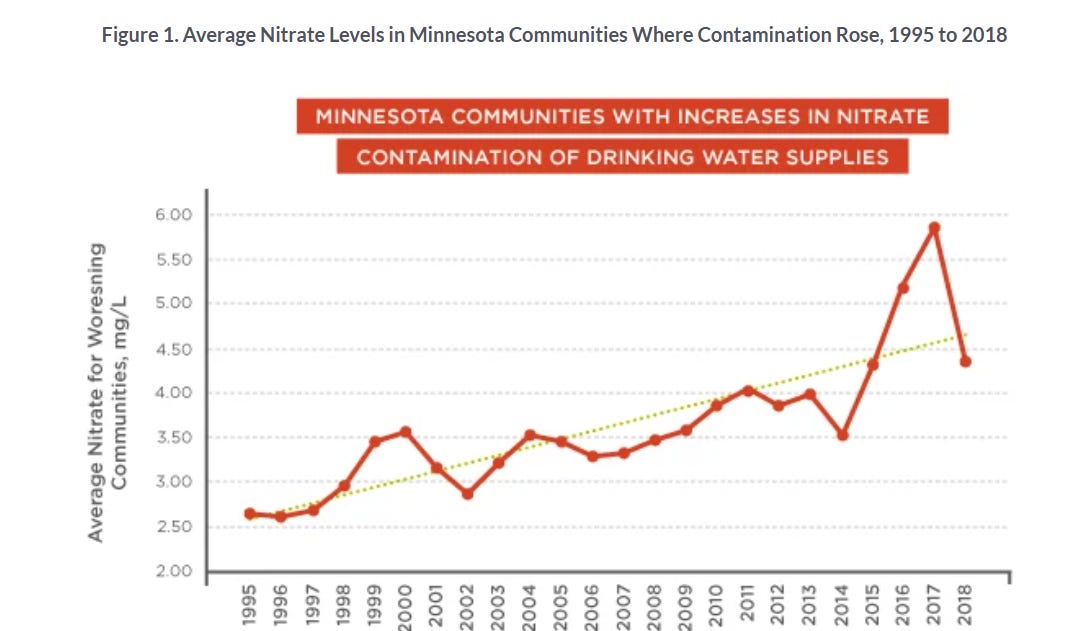
Why a Minnesota graph? Because Michigan doesn’t have enough data to create one that’s meaningful.
Thanks to newspapers.com, I was able to find Dave Dempsey of Clean Water Action telling reporter Dave Poulson in 1992 that “we’re cavalierly dismissing Michigan’s most severe groundwater problem because it’s [primarily caused by] agriculture, and agriculture gets treated with kid gloves.”
The head of the agriculture department at the time, Bill Schuette, said, “Farmers are Michigan’s first conservationists and stewardship is something farmers practice every day.”
Jump forward nine years. I was able to find a spokesperson for the Michigan Environmental Council telling a reporter in 2001, citing a report of which I was a co-author, “the discovery of nitrate-contaminated wells is becoming an increasingly common occurrence.”
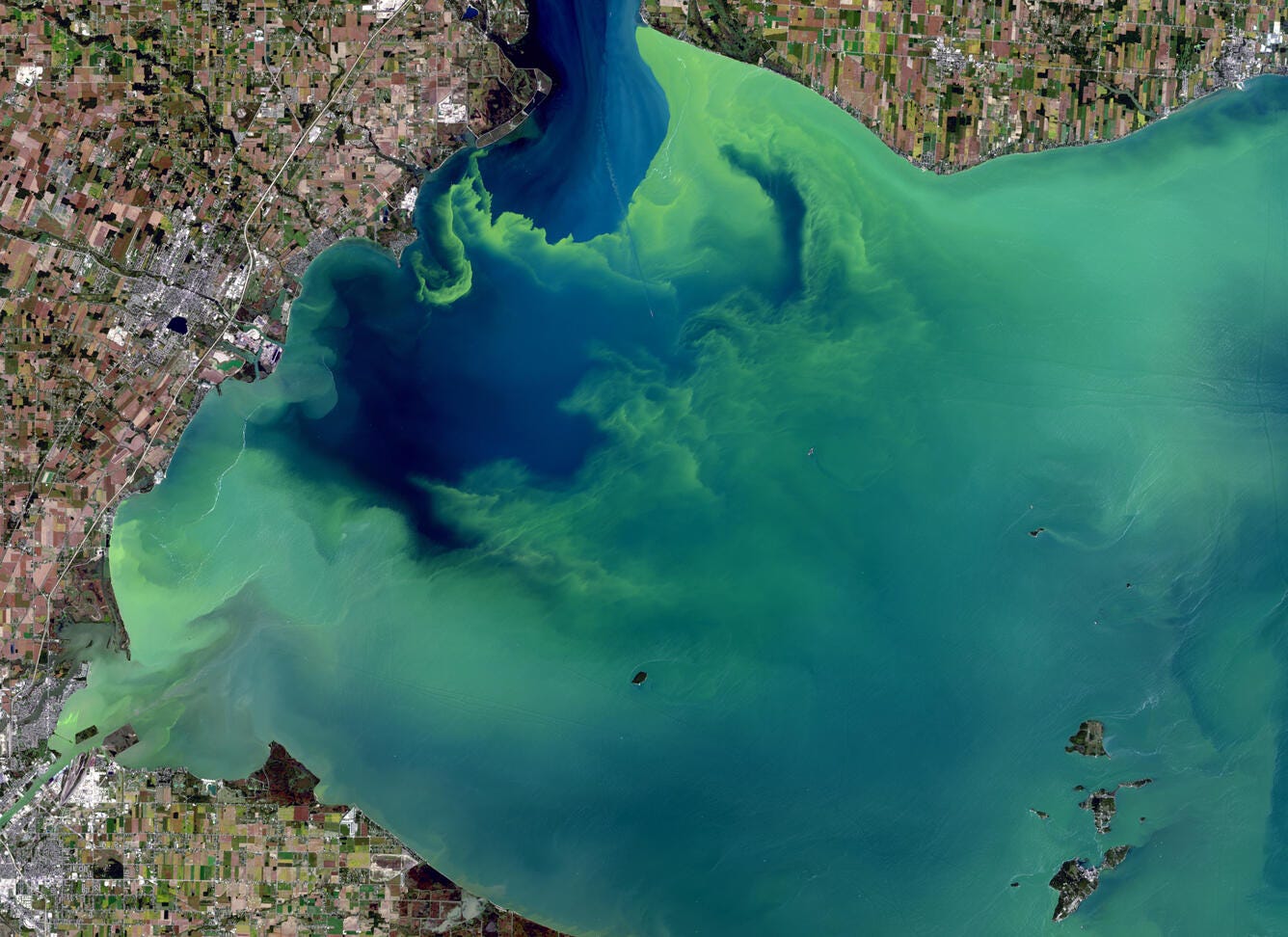
Western Lake Erie algae bloom.
And guess what? It still is. Thousands of rural wells across Michigan are polluted with nitrates generated from animal waste, fertilizer and failing septic systems.
In 1992 and 2001, the principal health effect feared from exposure to nitrates was methemoglobinemia, or “blue baby syndrome,” characterized by a blue appearance, sometimes fatal. That’s still a concern, but there is evidence today that chronic exposure to high levels of nitrates in drinking water contributes to a form of cancer. This has not added to anyone’s urgency to solve the problem.
The advantage Michigan has in failing to deal with the problem is that it has kept data about nitrate contamination limited, scattered and often outdated. At least you can find nitrate pollution information in Wisconsin, Minnesota and Iowa, nearby states with severe nitrate problems.
Our state has done almost nothing about the problem other than shelling out money to pay farmers for “demonstration projects” that lead to more demonstration projects that lead to…
There are other significant problems that were significant in the 1990s that are at least as significant today. Contamination sites allowed to spread instead of being cleaned up. (I wrote a report about that in 2000) A permanent Asian carp barrier in Illinois that was urgently needed in 2002 but still hasn’t been built. Lake Erie algae blooms worsening.
We knew we should act on all of these in the 1990s; we know we should act today. Instead, it’s possible some kid working for an environmental group will be able to turn to whatever follows the internet and quote a century-old report about the ever-worsening problem of nitrate contamination of Michigan’s groundwater in 2092.
It is impossible for me not to be angry about that. And to wonder why I wasn’t successful in doing more about it.
It's not from a lack of trying Dave. And boy do I get that. It's been 20 years and I still haven't seen a septic code for Michigan. But we keep at it. My nitrate battle is with riparians who love their suburban lawns and think using "lake safe" fertilizer is a good thing. I can't get them to understand that this stuff still contains nitrates that will get into the lake. No such thing as lake safe fertilizer.
This is an important wakeup call. Much progress was made to control phosphates in years past, but we shouldn’t be lulled into complacency—as you so correctly point out, there are other concerns and there is more work to be done!